
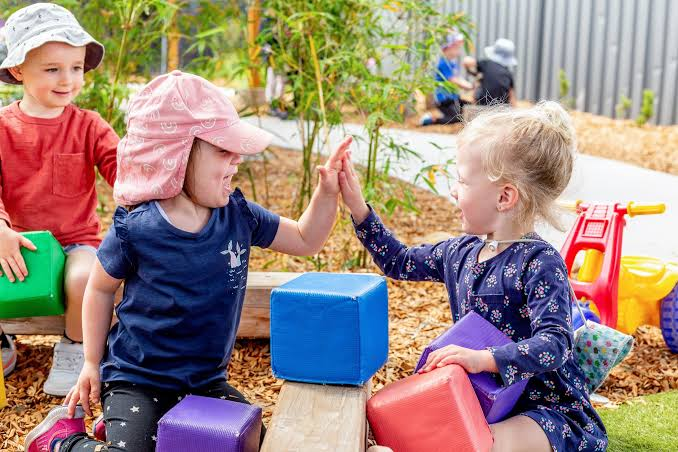
There is a common misconception that children are “just playing” when they build block towers, argue over who gets the red crayon, or splash through a sensory tray. In reality, those seemingly simple moments are some of the most cognitively demanding experiences a young child will have. At a quality early learning centre in Randwick, play is not a break from learning. It is the learning.
What Play-Based Learning Actually Looks Like
Play-based learning is structured around the idea that children absorb concepts most deeply when they are engaged, curious, and in control of their own exploration. Educators do not just set out toys and step back. They design the environment intentionally, observe how children interact with it, and step in to extend thinking at the right moment.
A child sorting coloured blocks is practising early mathematical reasoning. A group of three-year-old children negotiating who plays the “doctor” in a pretend clinic is navigating social hierarchies, turn-taking, and empathy, all at once. The play looks spontaneous, but the learning underneath is deliberate.
How Maths Shows Up in Everyday Play
Children do not need a worksheet to encounter mathematical thinking. When children experience maths through their bodies and their play, abstract concepts become concrete.
For example, using blocks, movement games, or hand‑based counting links number and shape ideas to physical experience, making learning more memorable. A 2017 study on “Support of Mathematical Thinking through Embodied Cognition” shows that when children use gestures and manipulatives, their understanding of number and spatial patterns is deeper and more durable than when they rely on rote memorisation alone.
At well-run childcare centres, Educators integrate numeracy into daily routines and play naturally:
- Counting and sequencing through songs, jumping games, and setting the table for lunch
- Sorting and classifying with natural materials like shells, leaves, and blocks of different shapes
- Spatial reasoning during construction play, puzzles, and obstacle courses
- Measurement and comparison when children pour water between containers or compare how tall their block tower is
These everyday experiences allow children to “do” maths long before they meet a worksheet, turning abstract ideas into lived, body‑based understanding.
Language Development: More Than Just Story Time
Language acquisition at this age happens in layers. Yes, story time matters, but the richer moments often happen in conversation. When an Educator sits down beside a child building a sandcastle and asks open-ended questions (“What happens if we add more water? What do you think will change?”), they are building vocabulary, encouraging reasoning, and modelling how language is used to express ideas.
At a good Randwick childcare centre, language-rich environments are everywhere, not just in the book corner. Signs at children’s eye level, labelled materials, storytelling prompts in the dramatic play area, and daily group discussions all contribute to early literacy in ways that feel natural rather than pressured.
In fact, A University of Oxford randomized trial of the NELI Preschool oral‑language programme found that 3–4‑year‑olds in nurseries who received 20 weeks of guided‑play‑linked language sessions made the equivalent of 3 months’ additional progress in oral‑language skills compared with control peers.
Key language skills developed through play include:
- Expressive language (using words to communicate needs and ideas)
- Receptive language (understanding what others say)
- Narrative skills (sequencing events and retelling stories)
- Phonological awareness (recognising sounds and rhymes, a precursor to reading)
Social Skills: The Hardest Curriculum to Teach
Ask any Educator what the trickiest part of early childhood is, and many will say the social-emotional piece. Learning to manage frustration, share space with others, read facial expressions, and resolve conflict without melting down, these are skills adults still struggle with.
Play gives children a low-stakes environment to practise. When a child at a daycare in Randwick experiences a disagreement in a game and works through it with peer support and Educator guidance, they are building emotional regulation and social confidence in real time.
High‑quality early‑learning programs don’t just support language and cognition; they also help children build essential social skills. In a structured preschool setting, children learn to share, take turns, negotiate conflicts, and cooperate through guided play and group activities.
A 2019 study published in the International Journal of Environmental Research and Public Health found that children’s social skills are significantly stronger in preschool than at home, highlighting how early‑learning environments actively scaffold cooperation, communication, and emotional regulation.
The skills built in the early years are not peripheral to future success. They are central to it.
What Families Should Look for in a Centre
When families search for childcare near me or a trusted Randwick childcare centre, the quality of play programming should sit at the top of the checklist. A few things worth observing:
- Are Educators actively engaged with children during play, or mostly supervising from a distance?
- Does the environment offer open-ended materials that invite creativity?
- Is there a balance between child-led and Educator-guided experiences?
- Do Educators talk about learning in terms of observations and individual children, not just group activities?
The Bottom Line
Children do not switch off when they play. If anything, they are operating at full capacity. The early years are a narrow window where the brain is primed for exactly this kind of experiential, relationship-based learning. Families who choose a centre that genuinely understands play-based pedagogy are giving their children more than a safe place to spend the day. They are giving them a strong start.