
Over the past year, leaders everywhere have been encouraged to build their AI capability. Learn to prompt. Ask better questions. Generate faster outputs.
And yes, that matters but here’s the shift most didn’t see coming:
Prompting is not the new superpower – persuading is.
Because AI can now generate ideas, summaries, report – even full presentation drafts – in seconds. Which means the real differentiator is no longer what gets produced.
It’s what happens next.
I’m increasingly seeing leaders walk into meetings with beautifully written, AI-generated content that sounds smart, looks polished… yet it fails to gain traction. There’s no real buy-in, no movement, and ultimately, no decision.
Not because the idea isn’t good, it’s because it hasn’t been shaped for the audience or delivered in a way that actually influences thinking and that’s the real capability gap emerging right now.
What’s the gap?
It’s not really technical skill. It’s communication skills!
Which is exactly why more organisations are investing in corporate public speaking training and practical communication development as well as technical AI capability.
The New Leadership Skillset
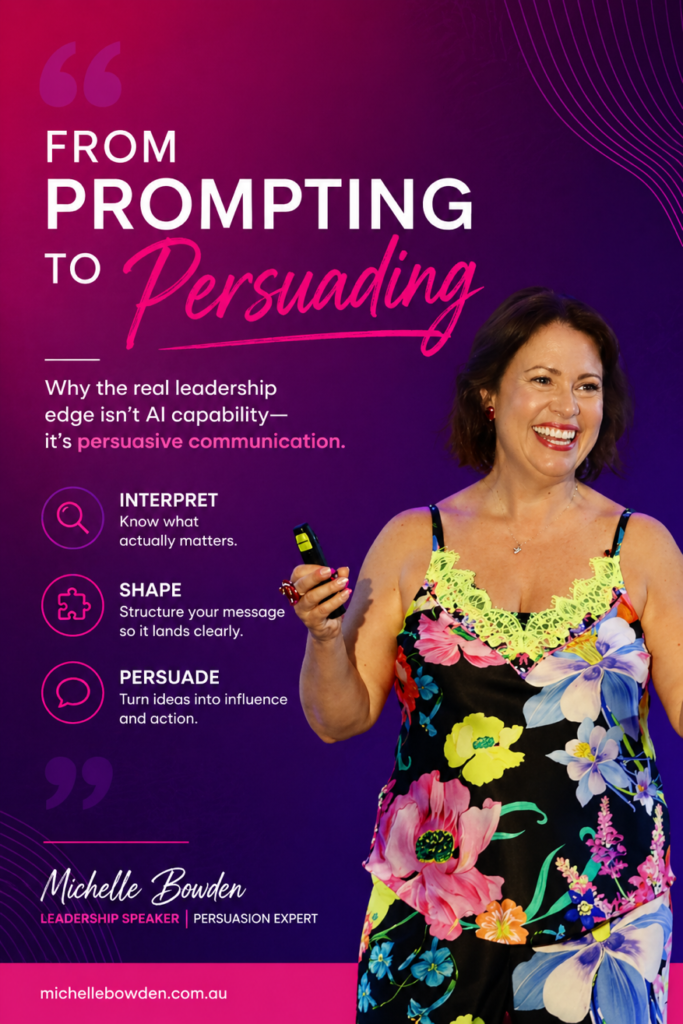
Leadership has never been about information. It’s about influence. The leaders who will stand out in this next phase are the ones who can take AI output and do three things exceptionally well:
Interpret. Shape. Persuade.
Interpret means knowing what actually matters. AI is fast but it’s not discerning. Leaders need to filter, prioritise, and identify what’s relevant.
Shape means structuring a message so it flows logically and lands clearly. This is where many fall back into old habits: overloading content or over-explaining instead of communicating clearly. It’s something I see often when working as a public speaking coach with leaders across industries.
Persuade is where the real leverage sits. This is where a “good idea” becomes a supported idea. A funded idea. A greenlit idea.
And no, AI can’t do that part for you without some masterful human input!
Where AI Does Add Power
What’s interesting is that AI doesn’t replace persuasion, it amplifies it. If you understand how persuasion works, you can actually prompt AI to be more persuasive in the first place.
Instead of asking AI to “write a presentation,” you can guide it with intent:
- Ask it to frame your idea for a specific audience
- Ask it to address likely objections
- Ask it to structure your message with a strong opening and close
In other words, you’re not just generating content, you’re directing it.
And that’s a very different skill.
Understanding the best practice frameworks that should be informing your AI prompting is a core focus in my public speaking courses in Sydney. You need to learn how to think, structure, and communicate with intention rather than defaulting to content overload.
From Theory to Practice: The MB Bot – a Salesforce case study
This is exactly where I’ve been focusing my work. In collaboration with Salesforce, we developed an AI-powered tool called the MB Bot (yes we named it after me!) It’s a very cool chatbot designed to help sales professionals apply best-practice formulas for analysis, design, and delivery.
The goal wasn’t to automate communication.
It was to improve it.
The MB Bot guides Salesforce users through structured thinking, helping them analyse their audience, design a clear message, and deliver it using proven persuasion frameworks.
Because structure drives clarity and clarity drives influence.
The Missing Piece: Language That Persuades
Interestingly structure alone isn’t enough. The real shift happens in the language.
One of the most powerful aspects of my work is the Persuasion Blueprint – a set of linguistic patterns designed to engage audiences from the very first moment and leave them with a clear, compelling takeaway.
These patterns are especially critical in the opening and closing of a presentation because that’s where you win attention and secure action.
And here’s where AI becomes incredibly useful.
When people attend my programs whether that’s Public speaking training in Sydney or a practical public speaking workshop they don’t just learn the theory. They’re given AI prompts specifically designed to fast-track the writing of these linguistic patterns.
So instead of staring at a blank page, they can generate strong, persuasive openings and closings quickly then refine them with their own voice and intent.
It’s a powerful combination: Human insight + structured persuasion + AI acceleration.
Why This Matters Now
We’ve entered a world where everyone has access to the same tools. Everyone can generate content. Everyone can sound “smart.” So sounding smart is no longer the advantage, clarity relevance and persuasion is.
Final Thought
So yes – get good at prompting but don’t stop there. Because the real leadership skill is in both prompting with audience behaviour in mind and then persuading real time. In a world full of content, the people who can shift an audience will always be the ones who shape the outcome.
To learn more about Michelle Bowden’s work as a public speaking coach and her programs in corporate public speaking training, visit: https://michellebowden.com.au/